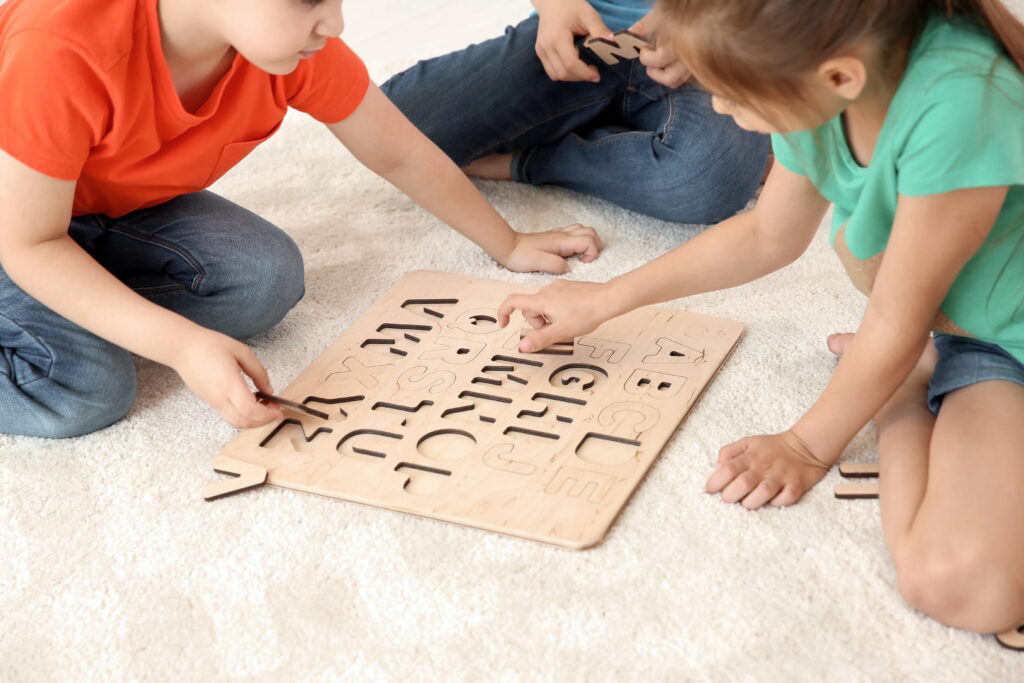
Fun word games for kids and families to play together offer an easy, screen-friendly activity built around bonding, learning, and entertainment. Fun word games for kids and families to play together require little setup, since a pen, paper, or a set of letter tiles often provides everything needed to begin. A shared game turns spare time into a moment of connection, replacing passive screen time with active participation from every family member. Vocabulary, spelling, and reasoning develop naturally during play, without a workbook or a formal lesson driving the experience.
Word games suit a wide range of ages and skill levels, making group play possible even when family members bring different reading abilities to the table. Younger children benefit from simple, visual formats (word searches, matching activities), while older children and adults enjoy added challenges (anagrams, timed scrambles, trivia). The article covers several types of word-based games, from simple starter activities requiring no equipment, through structured competitions families can build into a regular routine. Online tools add further variety, supporting practice between game nights or offering fresh challenges once a household exhausts a favorite format. Games covered ahead range from casual, five-minute activities to longer sessions suited for a dedicated family game night.
Why are Word Games Good for Family Activities?
Word games are good for family activities because the format encourages vocabulary development, spelling practice, problem-solving, concentration, and friendly competition without resembling formal studying. Vocabulary expands naturally as unfamiliar words surface during play, absorbed through context rather than memorization. Spelling improves through repeated exposure to correct letter arrangements, reinforced during active gameplay rather than a worksheet. Problem-solving strengthens as a player evaluates multiple letter combinations or clues before settling on an answer. Concentration builds through sustained attention on a single puzzle or round, particularly during a timed challenge. Friendly competition adds motivation, since a scored round or a race against the clock keeps energy high throughout a session.
A family gathered around a word game rarely feels like a classroom exercise, since the entertainment value carries the learning alongside it. Genuine enjoyment sustains participation across repeated sessions, building consistent practice through an activity families choose to return to on their own.
What are Some Easy Word Games for Kids?
Easy word games for kids include word searches, anagrams, word scrambles, categories, and letter-based challenges, each requiring little or no equipment. Word searches present a grid of letters containing hidden words, requiring a child to scan systematically until a full list is located. Anagrams rearrange the letters of one word or phrase into a different valid word, offering a light mental challenge suited to short sessions. Word scrambles present a jumbled set of letters, requiring rearrangement into a single correct word, often built around a simple theme for younger players. Categories challenge a group to name words fitting a specific topic (animals, foods, colors) within a time limit, encouraging quick recall under light pressure. Letter-based challenges ask a player to generate as many words as possible from a small set of starting letters.
A pencil, paper, or a printed grid covers most of these games, keeping preparation minimal. Simple formats work well for younger children, while a slightly larger letter set or a shorter time limit adds challenge for an older sibling playing alongside them.
Can Unscrambled Words Improve a Child’s Word Game Ability?
Yes, unscrambled words can improve a child’s word game ability. Repeated exposure to correctly formed words strengthens recognition of common letter patterns, spelling structures, and familiar combinations. A child working through a scramble learns to test multiple arrangements before settling on a valid answer, building comfort with trial and adjustment. Recall improves gradually, since a word encountered and solved once becomes easier to recognize during a future round. Confidence grows alongside skill, as a child who successfully unscrambles increasingly difficult sets approaches the next challenge with less hesitation. Regular practice across varied word lengths builds a stronger overall foundation for word-based games generally.
How Can Parents Make Word Scramble Games More Fun?
Parents can make word scramble games more fun by adjusting difficulty, adding themes, setting time limits, forming teams, and providing clues. Difficulty levels help children with different skill levels participate without making the activity too easy or too difficult. Parents can begin with short familiar words, then introduce longer or less familiar words as confidence grows.
Parents can add animal, food, school, holiday, or science themes to connect each scramble with familiar interests or learning topics. A short time limit adds excitement for children ready for faster challenges, while clues provide support when a puzzle becomes difficult. Team play adds discussion and shared reasoning, making the activity suitable for siblings or mixed-age family groups. Scrambled-letter games therefore adapt easily to different abilities through word length, themes, timing, clues, and team formats.
How can you Create a Word Scramble Activity at Home?
Creating a word scramble activity at home requires only a few simple steps. First, choose a theme matching a family’s interest, selecting a topic (animals, sports, holidays) that keeps the activity engaging from the start. Second, select a group of words connected to that theme, adjusting word length based on the ages of the players involved. Third, scramble the letters of each chosen word, mixing the order enough to require genuine thought without becoming unsolvable. Fourth, write the scrambled sets onto paper, cards, or a shared screen, leaving space for players to write a final answer. Fifth, set a time limit appropriate for the group, giving younger children extra time while keeping older players moving quickly. Lastly, review the answers together as a group, discussing any word a player found difficult before moving toward a next, slightly harder round. A short setup process keeps the activity ready within minutes whenever a family wants to play.
Can Word Scrambles Help Children Practice Spelling?
Yes, word scrambles can help children practice spelling. Rearranging letters into a correct word requires close attention to letter order, reinforcing accurate spelling through direct, hands-on practice. Repeated exposure to a word’s correct structure builds memory for common spelling patterns encountered across multiple rounds. A child working through a difficult scramble often tests several possible arrangements, strengthening awareness of which combinations form valid words and which do not. Consistent practice across weeks builds noticeable improvement in spelling accuracy, since active engagement with letters reinforces retention more effectively than passive review of a word list. Scrambles keep spelling practice enjoyable, sustaining regular engagement without feeling like a graded exercise.
How can Families Turn Word Scrambles Into a Competition?
Turning word scrambles into a family competition follows a straightforward sequence. First, gather every participant and confirm a shared understanding of the basic scramble rules before adding a scoring system. Second, prepare a set of scrambled words in advance, varying in difficulty to keep the competition fair across different ages. Third, assign points based on word length or difficulty, rewarding a correctly solved, longer word with a higher score than a short, simple one. Fourth, set a shared time limit for each round, keeping every player working under the same conditions. Fifth, track scores on a shared sheet or board, updating the total after each completed round. Lastly, announce a winner once every round concludes, then discuss standout words or particularly tricky scrambles as a group. A simple point system turns a familiar activity into a lively, competitive event that families can repeat regularly.
How can Families Set Rules for a Word Scramble Competition?
Setting rules for a word scramble competition works best through a short, agreed-upon structure established before play begins. First, decide how many rounds the competition includes, keeping the total short enough to hold attention across every age group. Second, agree on a scoring method, assigning higher point values to longer or more difficult words. Third, set a consistent time limit per round, applying the same limit to every player to keep the competition fair. Fourth, decide whether players compete individually or in teams, adjusting group size to balance skill levels across the family. Fifth, confirm how a tie gets resolved, whether through a tiebreaker round or a shared win. Lastly, write the agreed-upon rules down or review them aloud before the first round starts, avoiding confusion once the competition gets underway. Clear rules established early keep the event focused on fun rather than disagreement.
Can Players Earn Points for Finding Words Quickly?
Yes, players can earn points for finding words quickly. A timed scoring system rewards speed alongside accuracy, giving an early, correct answer a higher value than a later one. Quick recognition of a valid word encourages faster mental processing, since a player benefits from scanning letter combinations efficiently rather than testing options slowly. Speed-based scoring adds energy to a competition, keeping every round lively rather than drawn out. A family choosing this format often layers speed bonuses onto a standard difficulty-based point system, rewarding both a correct answer and a fast one within the same round.
What Other Word Games Can Families Try?
The other word games families can try are listed below.
- Scrabble: Scrabble builds words from letter tiles placed on a shared board. Players score points based on letter values and tile placement.
- Boggle: Boggle challenges players to find connected words within a set time limit using a grid of shuffled letter cubes.
- Word Search: Word Search asks players to find hidden words scattered across a letter grid. Players scan horizontally, vertically, and diagonally to locate each word.
- Crossword Puzzles: Crossword Puzzles require solving clues to complete intersecting words. Players fill the grid one answer at a time while using the clues to guide each solution.
- Charades: Charades has players guess words or phrases through actions and gestures alone. The activity adds movement and laughter to family word-based play. Similar word games provide additional puzzle formats, with Unscramble BOGGLE offering another letter-based challenge.
What is the Difference Between an Anagram and a Word Scramble?
An anagram is a word or phrase formed by rearranging every letter of a different word or phrase, producing a new, complete word using the exact same letters. A word scramble presents a jumbled version of a single target word, requiring a player to rearrange the letters back into their original, correct order. An anagram often transforms one finished word into an entirely different finished word, while a scramble typically works toward one specific, predetermined answer. Anagram puzzles sometimes allow multiple correct solutions from a single letter set, while a scramble usually points toward a single intended word tied to a clue or theme.
Families exploring the distinction further can try an Anagram Solver for generating valid word combinations from a chosen letter set, offering a hands-on way to see the difference between the two formats during actual play.
How can Parents Use Online Word Games for Family Learning?
Parents can use online word games for family learning by turning letter challenges, clues, patterns, and vocabulary tasks into shared problem-solving activities. First, parents select word games that match the children’s reading level and learning goals. Second, family members solve anagrams, crosswords, or word puzzles together while discussing possible answers and reasoning. Third, parents encourage children to explain why an answer fits the available letters, clues, or rules. Lastly, families review unfamiliar words after each activity and connect new vocabulary to reading, spelling, or school subjects. Word games involve pattern recognition, logical reasoning, data organization, rule testing, and strategic choices, which connects recreational play with computational thinking skills. Family learning gains a focused digital activity through Word Games that combines shared participation with vocabulary practice and structured problem-solving.
How can Families Make Word Games Part of Their Regular Routine?
Making word games part of a regular routine works well through small, consistent scheduling choices. First, pick a recurring time (a weekend evening, a weekday dinner) that already fits the family’s schedule. Second, keep a small set of go-to games ready, avoiding time lost searching for materials before a session begins. Third, rotate between formats regularly, alternating between scrambles, board games, and online activities to maintain interest. Fourth, involve every family member in choosing a game occasionally, building enthusiasm through shared ownership of the routine. Fifth, keep sessions short during busy weeks, since a brief ten-minute round still reinforces the habit without adding pressure. Lastly, celebrate small wins and funny moments along the way, reinforcing the activity as an enjoyable tradition rather than an obligation. A consistent, low-pressure schedule turns word games into a lasting family habit rather than an occasional activity remembered only sometimes.
What Should Parents Consider When Choosing a Word Game?
Parents should consider age suitability, skill level, group size, available time, and learning goals when choosing a word game. Age suitability determines whether a game’s vocabulary and rules match a child’s current reading ability. Skill level affects enjoyment directly, since a game too difficult discourages participation while one too simple loses interest quickly. Group size shapes format choice, as some games (Charades, team scrambles) suit larger gatherings while others (Scrabble, crosswords) work well with smaller groups or solo play. Available time influences game length, since a quick word search fits a short window while a full Scrabble match requires a longer, dedicated session.
Learning goals shape final selection, whether a family prioritizes vocabulary growth, spelling practice, or simple entertainment during a chosen session. Matching a game to these factors keeps the activity enjoyable and appropriately challenging, supporting continued interest across repeated family game nights rather than a single, one-time attempt.
What are Some Reliable Resources for Learning About Word Games?
Reliable resources for learning about word games are available across several established sources. Wikipedia offers general background on anagrams and word games, covering the history and mechanics behind common formats. Britannica provides a broader educational context around word games and wordplay, tracing the format’s development alongside related puzzle types. PBS Kids offers age-appropriate family game recommendations, curating activities suited for varied reading levels and family sizes. Together, these sources support a well-rounded understanding of word games, from historical background through practical, family-friendly game suggestions suited for regular home use.